When a complaint lands on your desk, the single most consequential decision you’ll make is not who to interview or what to ask.
It’s the decision that comes before any of that: Does this warrant a formal investigation, an informal resolution, or a documented decision to take no further action?
GET THE COMPLAINT COMPASS™ FOR $27!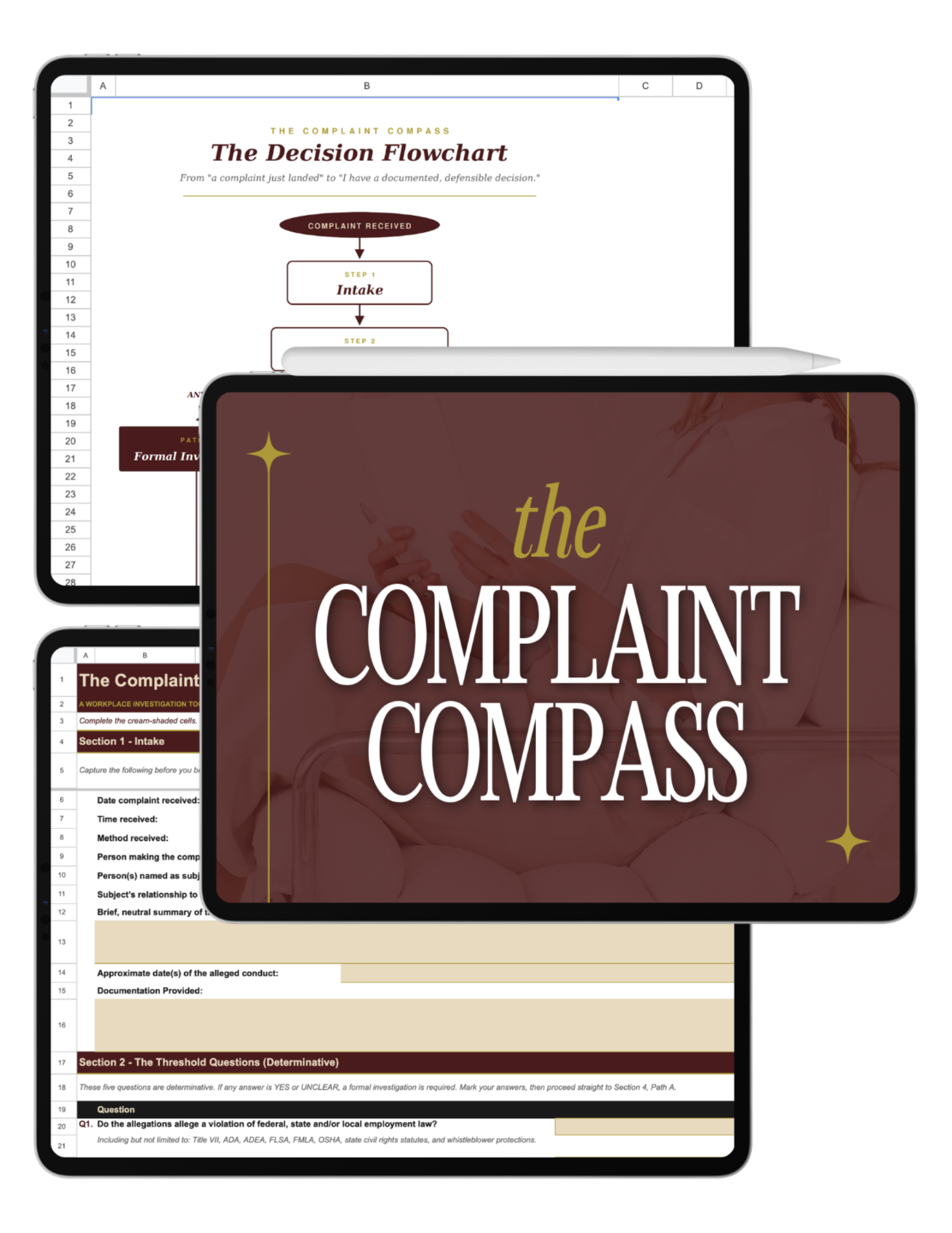
The next time a complaint lands on your desk, you won’t sit with it for hours wondering,
“Do I have to investigate this?”
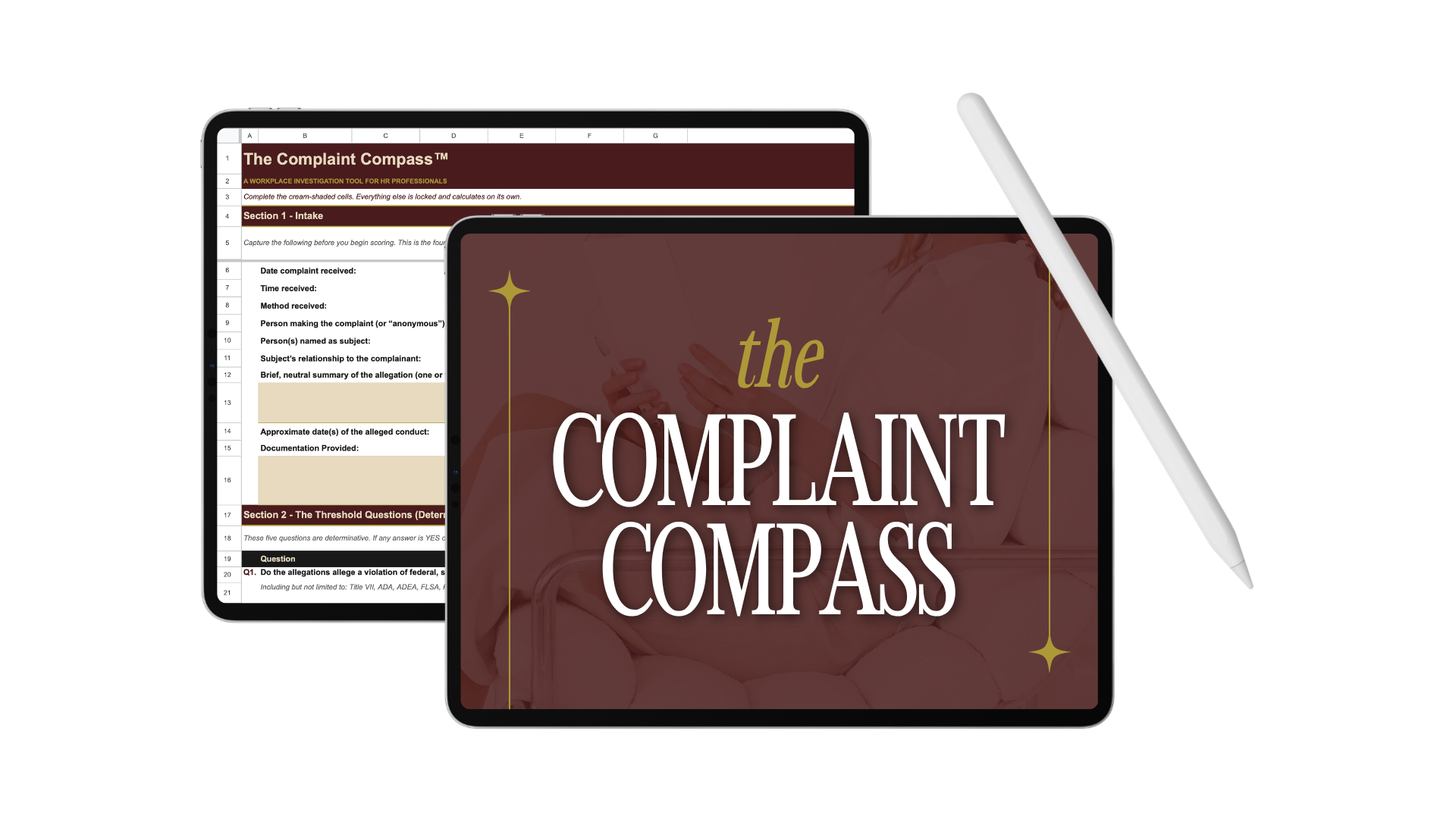
The Complaint Compass helps you stop second-guessing whether to investigate.
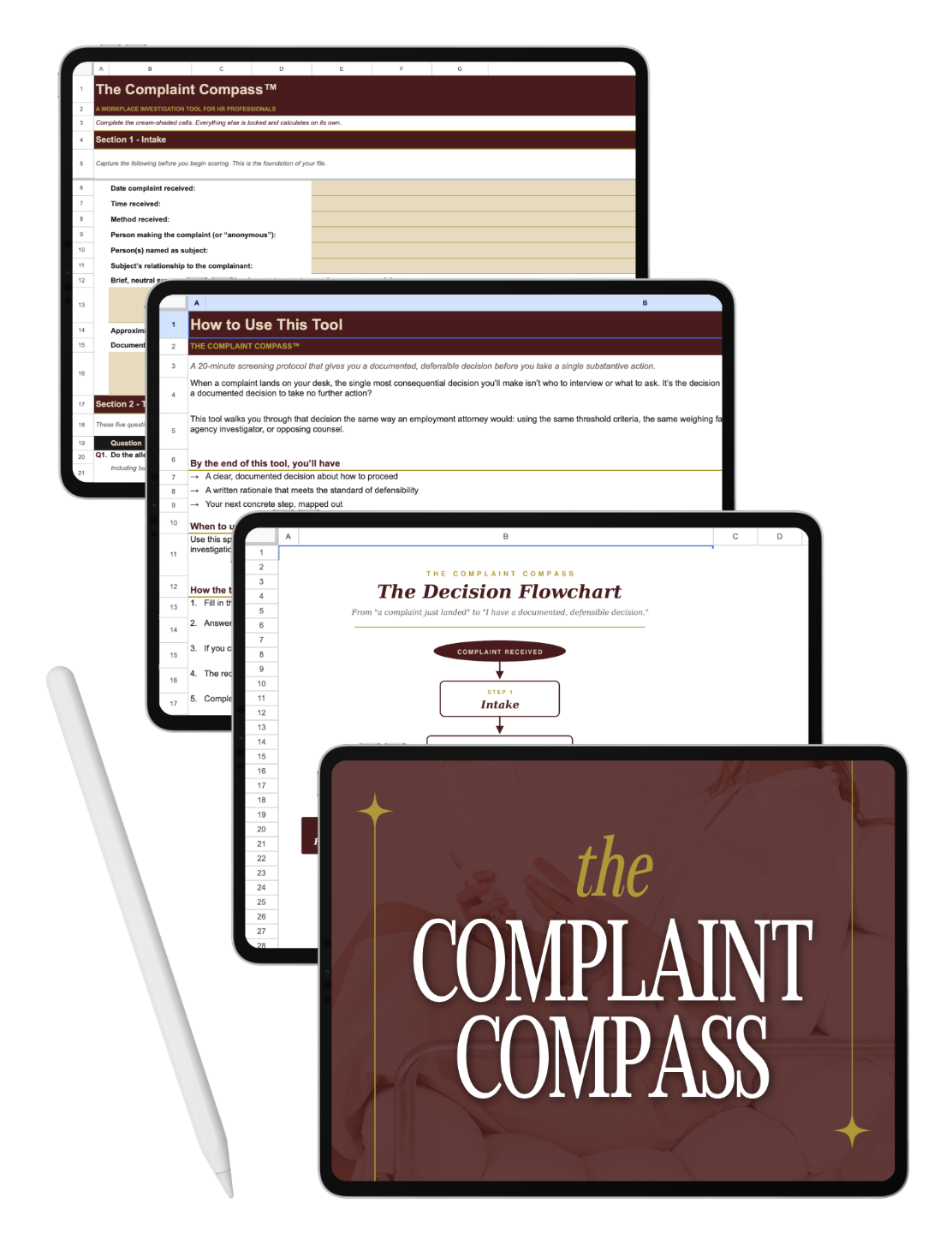
The Complaint Compass™ is an attorney-vetted screening tool that walks you through the same threshold analysis an employment attorney would conduct, and leaves you with a documented, defensible decision: investigate formally, resolve informally, or take no further action…all in under 20 minutes.
You’re probably wondering how the Compass tool works. Let me walk you through a common scenario…
It’s 3:47 on a Tuesday. You're preparing to send a few emails before ending your day at 4:30…when all of a sudden you receive an email, marked high priority, and then less than 30 seconds later, a phone call.
It’s the regional manager from Site 7. A reporter from the local paper has called him twice. They have “sources” saying two women on his team have made complaints about a senior leader harassing them. He doesn’t know what the specific allegations are, but only that they sound “pretty serious.” He tells you that the article runs Thursday morning, with or without a comment from the company.
The problem is…no one has filed anything. Not officially. You’ve heard whispers about the senior leader in the break room from time to time, but you just considered those whispers to be “gossip” from disgruntled employees. You hear gossip all the time, and you assumed those rumors would die down on their own.
Now the manager wants to know what HR is going to do. Legal is in a deposition. The COO is on a plane. And, you’re at a small company with no dedicated PR department to handle media inquiries.
It's all on you
You have two or three hours, maybe, before that reporter calls back...
The questions begin to swirl in your head…

Do we acknowledge what we’ve heard?
Do we deny it?
Is the media inquiry considered a complaint now?
Did the rumors constitute legitimate complaints that we failed to act on?
Do I have to investigate something no one has formally reported? If I do, where do I even start? If I don’t, and the article runs, what’s our defense?
You’re disoriented…and understandably so.
Here’s the good news: You don’t need to know what to do just yet. You need to know what to decide. And right now, you don’t have a way to make that decision, at least not one you’d feel comfortable defending six months from now when a lawyer reviews every text, email, and Slack message you sent today.
Here’s what most HR trainings don’t tell you about moments like that one: the decision you make in the first few hours after you receive a complaint is just as important as anything you’ll do during the investigation itself.

Get it “kind of right” but not write it down?
A significant intake-stage mistake is deciding not to initiate a formal investigation, but failing to document the rationale supporting that decision. Even if your assessment of the complaint is reasonable and appropriate, the absence of contemporaneous documentation can cause you to lose the single most protective document in your entire investigative file. In litigation, the question isn’t just what you decided, it’s what documentation you use to support the decision you made.

Get it wrong by skipping an investigation you should have done?
You’ve now created an organizational risk for your employer. Opposing counsel will use this against you: “You knew about the conduct and chose not to act. You’ve waived any defense that you acted with reasonable care given your knowledge and the circumstances.”

Get it wrong by launching a full-scale formal investigation when a five-minute coaching conversation would have been more appropriate?
Unnecessary investigations can escalate conflict, rather than decompress it, damage employee trust, and consume substantial organizational resources. Effective intake assessment requires thoughtful triage to ensure the organization’s response is proportionate to the nature, severity, and risk presented by the complaint.
In two decades of practice, I’ve watched HR professionals lose their footing, not because they got the investigation wrong but because they couldn’t articulate why they made the decision they did at the very beginning.
Introducing the Complaint Compass
An attorney-vetted screening tool that helps you navigate that first decision the same way an employment attorney would.
In 20 minutes, you go from:
→ “I don’t know what to do with this” to → “I have a concrete next step I can take, and a fully defensible, written rationale I can put directly in the investigation file, dated and ready to execute.”
The Complaint Compass is not an abstract framework. Just the same screening tool I would use myself, made plain.
What changes when you have a Compass?
You stop sitting with a complaint for hours, or days, or weeks while you “think it through.” You make the decision in 20 minutes and move forward with confidence. Intake can often feel like walking into a dark room without a map.
With a Compass: that disorientation you have when you first become aware of a complaint gives way to direction.
What’s inside?
-
A complete Intake Form to capture every fact you need to start a defensible file
-
The five-question Threshold Assessment: this includes the determinative questions that decide whether you must investigate formally
-
The five-question Weighing Score: the secondary analysis that distinguishes informal resolution from a documented no-action decision
-
A printable Decision Flowchart to follow at a glance
-
A Working Spreadsheet that calculates your scores and provides the specific next step for each outcome
Designed to be used the same day a complaint comes in, and as a steady guide for what to do next. This tool is built for solo HR practitioners and small HR teams who can’t afford to wait three days to figure out what to do next.